
The Real Reason Chronic Stress Wrecks Your Body (It's Not Cortisol)
Cortisol is not the problem. Your thermostat is.
Search "cortisol" online and you will find detox teas, supplements, and influencers all promising to help you "lower your cortisol," as if cortisol itself is the thing making you sick. It is not. Cortisol is a normal, necessary hormone, and your body is supposed to produce it every day. The real problem is what happens to the system that regulates cortisol after prolonged stress, and that system is called the HPA axis.
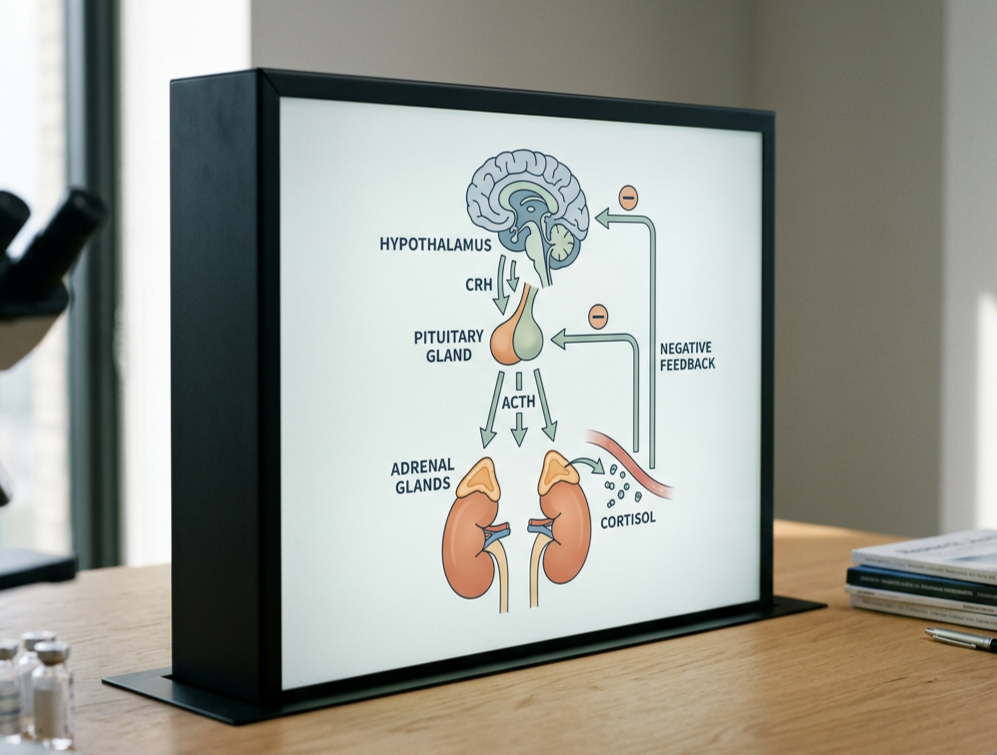
What the HPA axis actually is:
HPA stands for hypothalamic pituitary adrenal, which describes the three-step chain of communication your body uses to produce cortisol. The hypothalamus signals the pituitary gland (through CRH) , the pituitary gland signals the adrenal cortex (through ACRH), and the adrenal cortex releases cortisol into your bloodstream. Once cortisol is in circulation, it signals back to the hypothalamus and pituitary to slow down production. That last step is called negative feedback, and it is the part of the system that tends to get overlooked.
Think of the negative feedback loop like a thermostat. A thermostat does not just turn the heat on. It also senses when the room is warm enough and turns the heat off. Your HPA axis works the same way with cortisol. It is not just a system for producing cortisol when you need it, it is a system for sensing when you have enough and shutting production back down.
What chronic stress actually changes:
When people talk about chronic stress raising cortisol, what is usually happening under the surface is not a simple case of "too much cortisol." It is the feedback loop losing sensitivity. Over time, repeated stress exposure can make the hypothalamus and pituitary less responsive to the signal that is supposed to tell them cortisol levels are already high enough. The thermostat stops sensing the room accurately. Cortisol output becomes dysregulated: sometimes staying elevated longer than it should, sometimes flattening out into an unusual daily pattern, depending on the person and the type of stress involved.
This distinction matters because it changes what you are actually trying to fix. You are not trying to override a hormone. You are trying to restore the sensitivity of a feedback loop, which is a physiological process, not a willpower problem.
Why this matters for your health:
A dysregulated HPA axis does not stay contained to a feeling of being "stressed." Chronic stress and the resulting feedback loop dysfunction are linked to inflammation, weight changes, low energy, skin issues like acne, and elevated disease risk, including cardiovascular disease.
In fact, a 2024 systematic review and meta-analysis by Tsai and colleagues, published in the International Journal of Cardiology: Cardiovascular Risk and Prevention, found that dysregulated cortisol patterns were associated with a roughly 60 percent higher relative risk of cardiovascular disease, based on data from over 43,000 people across 33 studies. That is a meaningful signal, but it comes with real caveats worth stating plainly. This is observational and meta-analysis data, not randomized controlled trials, because you cannot ethically randomize people into chronic stress exposure. The confidence interval is also fairly wide, from 1.04 to 2.26, with the lower bound sitting close to 1.0. So the honest framing is that dysregulated cortisol is associated with higher cardiovascular risk, not that it directly causes it. That is still worth paying attention to, it just deserves accurate language instead of a scarier headline than the data supports.
The mechanism connecting chronic stress to inflammation is better established. Chronic stress is understood to drive glucocorticoid receptor resistance, meaning your body may still be producing cortisol, but your tissues stop responding to its normal anti-inflammatory signaling as effectively. Cortisol is present, it is just not being heard the way it should be.
Why I built the PEMS framework:
This is exactly why I do not think of stress management as one lever. Cortisol regulation is downstream of four categories I group under the PEMS framework: Physical, Emotional, Mental, and Spiritual. If any one of these is chronically misaligned, whether that is poor sleep, unresolved emotional stress, an overloaded mental load, or a lack of purpose and connection, it can show up as HPA axis dysregulation. Prevention means giving your body the environment it needs across all four areas so its own regulatory systems, like this feedback loop, can actually work the way they are designed to.
Test your own pattern instead of guessing:
If you want to know your actual cortisol pattern rather than assuming based on how tired or wired you feel, Eli Health's Hormometer lets you test cortisol at home.
Use code REALIGN for 15% off: https://eli.health/realign
Go deeper:
Want the full framework? Download the PEMS guide and learn how to manage chronic stress at the system level, not just the symptom level.
Partners I trust:
Allwear (non-toxic clothing), code REALIGN for 20 percent off, https://allwear.com/?rs_ref=cYfmU9a0
Attitude (EWG-verified skincare and beauty), code 10THEHOLISTICHEALTHENGINEER for 10 percent off, https://get.aspr.app/SH1n7R
Eli Health (Hormometer, at-home cortisol testing), code REALIGN for 15 percent off, https://eli.health/realign
Connect with me:
Instagram: instagram.com/theholistichealthengineer
YouTube: youtube.com/@theholistichealthengineer
Substack: substack.com/@theholistichealthengineer
The Cortisol Cure (E-Book): https://www.amazon.com/dp/B0DRSYMYSG
Citation:
Tsai et al., "Association of stress hormones and the risk of cardiovascular diseases: systematic review and meta-analysis," International Journal of Cardiology: Cardiovascular Risk and Prevention, Vol. 23, 2024 (DOI: 10.1016/j.ijcrp.2024.200305)